Solmex for construction and equipment fleets
This is the vertical Solmex was built in. It has run a live 520-machine road project for a year: excavators, loaders, graders, rollers, dump trucks and the light vehicles behind them, across projects and zones, serviced on hour meters and repaired where they stand.
Why Solmex
Most maintenance software was written for buildings and production lines, then sold to contractors. Solmex started at a road project with hundreds of machines, and it shows in the parts that usually go wrong.
01
Heavy equipment is serviced on the meter. Solmex schedules against the manufacturer's 250/500/1000-hour grid using live readings; a service logged late still leaves the next one where it belongs.
02
Breakdowns, services, inspections, fuel, parts, documents, permits and cost all hang off the same asset. Ten years and three sites later, the history is still attached to the machine it belongs to.
03
The field app isn't a shrunken desktop screen. Scan, report with photos, complete a job card, sign; in large targets, on a cracked screen, in sunlight, with patchy signal.
04
Not because chat is banned, but because a fault reported in Solmex has a machine, a photo, a severity and an owner. And it is still findable next March.
05
Reports read the same records the workshop works in. There is no monthly export, no reconciliation, and no version of the truth that only one person maintains.
06
Solmex runs a live 520-machine road-construction fleet across multiple projects and zones. It was built to that scale, not stretched to it.
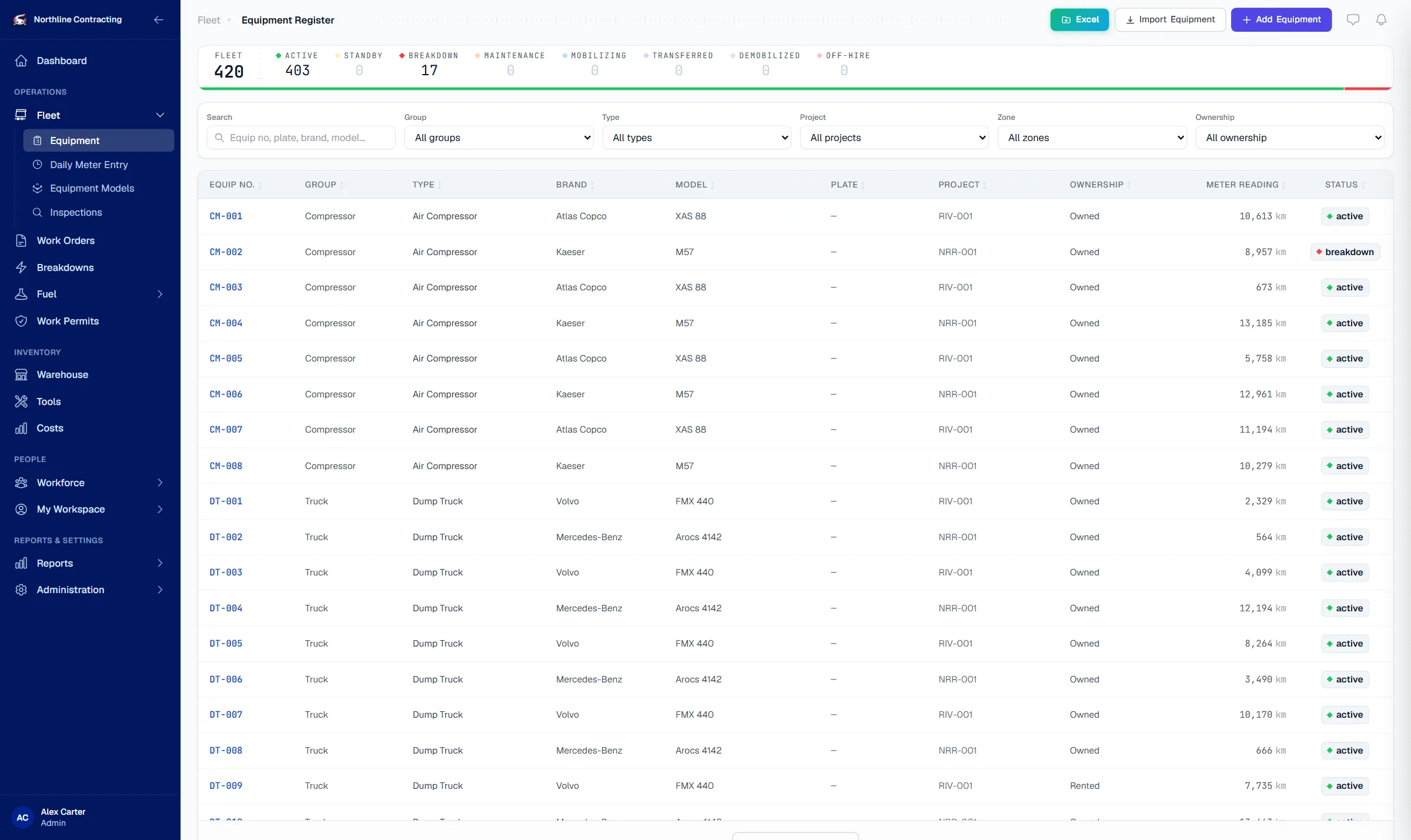
The Solmex platform
Solmex is equipment-centric by design. One record per machine, and every breakdown, work order, job card, part, and report flows from it. No duplicate data. No parallel spreadsheets. One source of truth that your whole operation orbits.
Inside a job
Three views of the same repair: the job as it was worked, the service that should have prevented it, and the walkaround that caught it first.
Work orders
From breakdown to sign-off: assignments, parts, photos, comments, and labor in one living record. The activity feed shows exactly who did what, when.
Dive deeper →Pressure test OK. Machine cleared to return.
320-4133 · boom cylinder seal kit ×1
Preventive maintenance
Service templates per asset class, due dates and due hours computed from live meter readings, and one-tap work order generation. Overdue services can't hide.
Dive deeper →Inspections
Structured checklists on any device. A failed item raises a finding; a finding becomes a work order with one tap. Nothing gets lost between the walkaround and the workshop.
Dive deeper →Timeline-driven maintenance
Nobody updates a status field in Solmex. The lifecycle is derived from what actually happens: a mechanic starts work, a part is issued, a supervisor signs off. The timeline assembles itself into a complete, trustworthy asset history.
Every step is a real operational event with an author, a timestamp, and evidence. Statuses can't be faked forward or forgotten.
The progress bar your managers see is computed from the record, not from someone remembering to move a card on a board.
Ten years from now, every hour, part, signature, and photo is still attached to the machine it belongs to.
Real people, real machines
The other half is a supervisor walking a machine at 6am, a storeman finding the right seal kit, a fitter with oil on his hands. Solmex was designed around those three people, not around an office chair.
Site footage in place of these scenes · get in touch if you would like us to film your operation
Get started
Send us a handful of your machines and we will walk you through Solmex using them: your equipment numbers, your service intervals, your problems. Thirty minutes, no slideware.