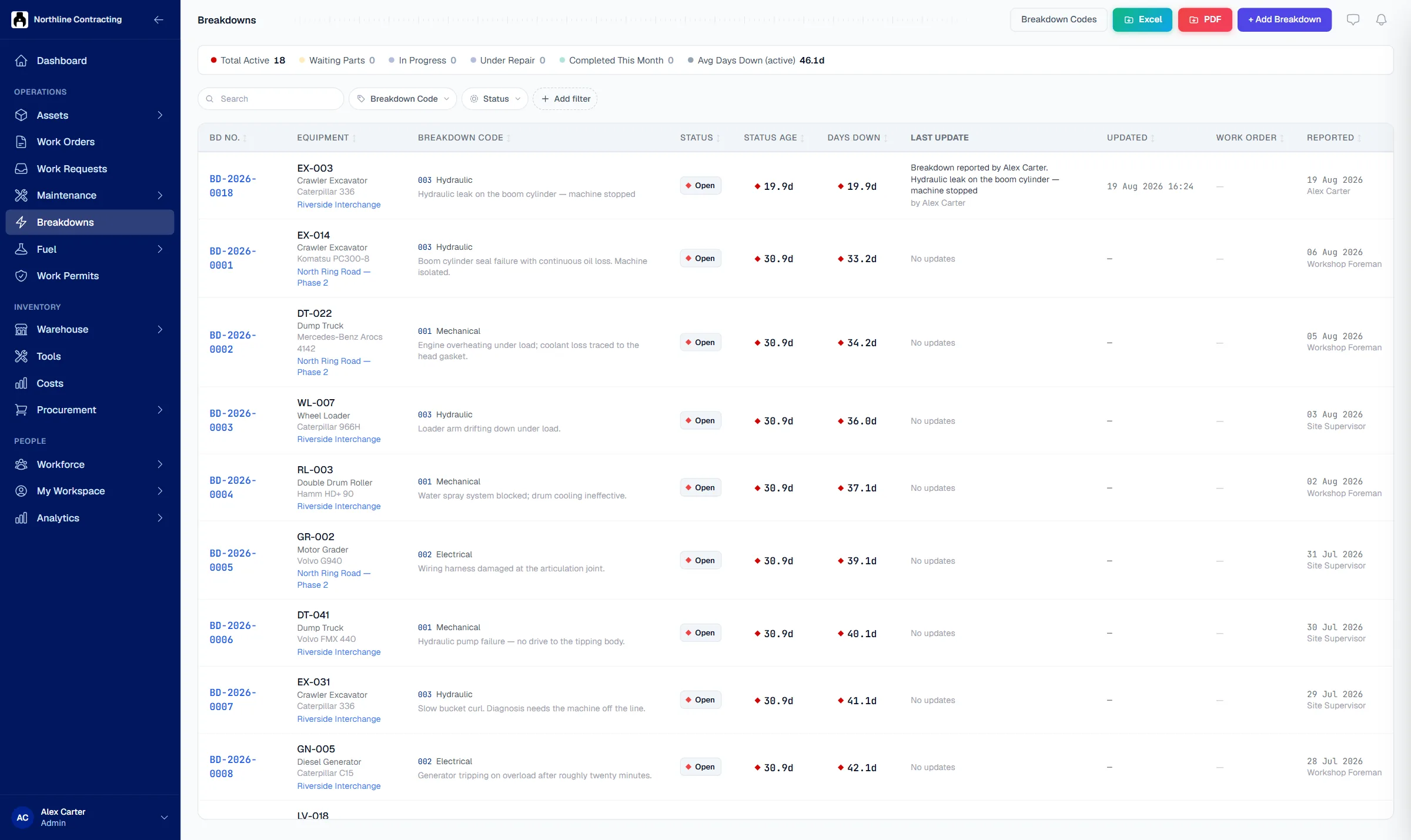
A breakdown is reported from the field in one tap — photo attached — and the machine's status flips itself. From that second, downtime is measured, not remembered.
Breakdowns
The fleet board turns red the moment the report lands — no phone chain, no morning-meeting surprise. And because status is derived from what actually happened, nobody can quietly mark a dead machine “active”.
Operators report from the mobile app with photos and a note — no forms, no radio relay. The report carries the machine, the location, and the clock, automatically.
Reporting a breakdown flags the machine fleet-wide; closing the repair restores it. Derived status means the register, the dashboard, and reality always agree.
Every breakdown carries its own stopwatch — reported to resolved. Recurring failures surface by machine and by cause, and the repair itself is tracked as a work order, so the fleet learns from every stop.
From the moment the fault is reported to the moment the machine is back in service, to the minute, on the machine's own record. The machine's status flips to breakdown by itself when a fault is logged and back when it is resolved, so fleet availability reflects what is actually happening rather than what somebody remembered to update.
It is cancelled, not resolved. Resolving means the failure happened and was fixed; cancelling means it did not happen. A cancelled breakdown leaves every statistic: it is not counted as downtime, not counted in the month's completions, and not counted in the repeat-offender ranking. The record is withdrawn and kept, never deleted, because it is the evidence of what was retracted and why.
Yes. The failure taxonomy is a tree you own, seeded with a default you can then rename, extend, re-code or archive. Renaming a code reaches every record filed under it; archiving one stops it being used on new records without changing what an existing record says.
Yes, an A4 landscape breakdown status report built to be read in under a minute and to survive being printed in black and white: fleet availability with its trend, the longest current downtime, an age band per breakdown, ranked insights, and one dense row per breakdown. Every age band carries a word as well as a colour, because colour alone does not print.
See a field report land, the fleet board flip, and the work order open itself — live, in a 30-minute walkthrough.
NO COMMITMENT · YOUR DATA STAYS YOURS