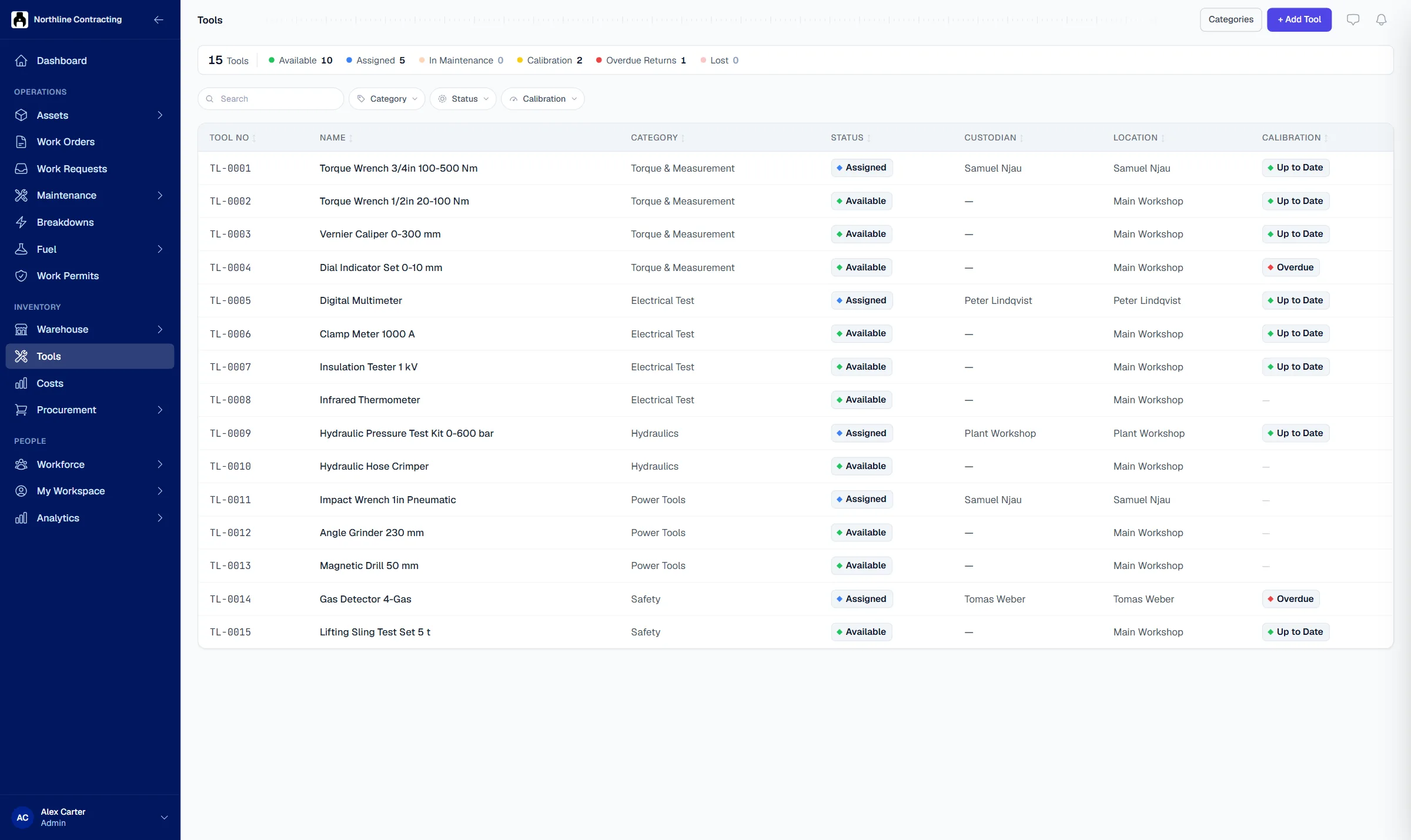
Torque wrenches, laser levels, test pumps — small iron walks off sites every week. In Solmex a tool is either in the store or signed out to exactly one person, and its whole travel history is on record.
Tool management
The system enforces one active holder per tool — you can't assign what isn't back. Returns close the loop, and every hand-off in between is a line in the tool's history.
Assign to a person, optionally against a work order. When a tool goes missing, the question isn't “where is it?” — it's “ask the last name in the ledger.”
Enter the certificate date once; the status — current, due soon, overdue — is derived from the calendar, not from someone remembering to update a spreadsheet cell.
Every tool gets a printed QR label. One scan on any phone opens its live record — holder, history, calibration — no app store, no login gymnastics in the field.
Knowing who has what, since when. Each tool can be assigned to exactly one person at a time, so the register always answers the question that actually gets asked when a torque wrench goes missing. Assignment and return are both recorded, so the history survives the person.
Yes. A tool carries its calibration interval and its last calibration date, and its status is computed from those on every read rather than stored, so a tool cannot sit in the register showing a calibration state that expired last month.
Yes, with the same QR labelling the rest of the system uses. Scanning a tool opens its record: what it is, who holds it, and when it is next due for calibration.
No, and keeping them apart is deliberate. An asset is a machine you maintain and cost; a tool is something you hand out and get back. Attachments such as buckets and breakers are assets, not tools, because they carry their own service history and mount on a host machine.
Scan a tool label, sign it out to a mechanic, and watch the crib board update — in a 30-minute walkthrough.
NO COMMITMENT · YOUR DATA STAYS YOURS