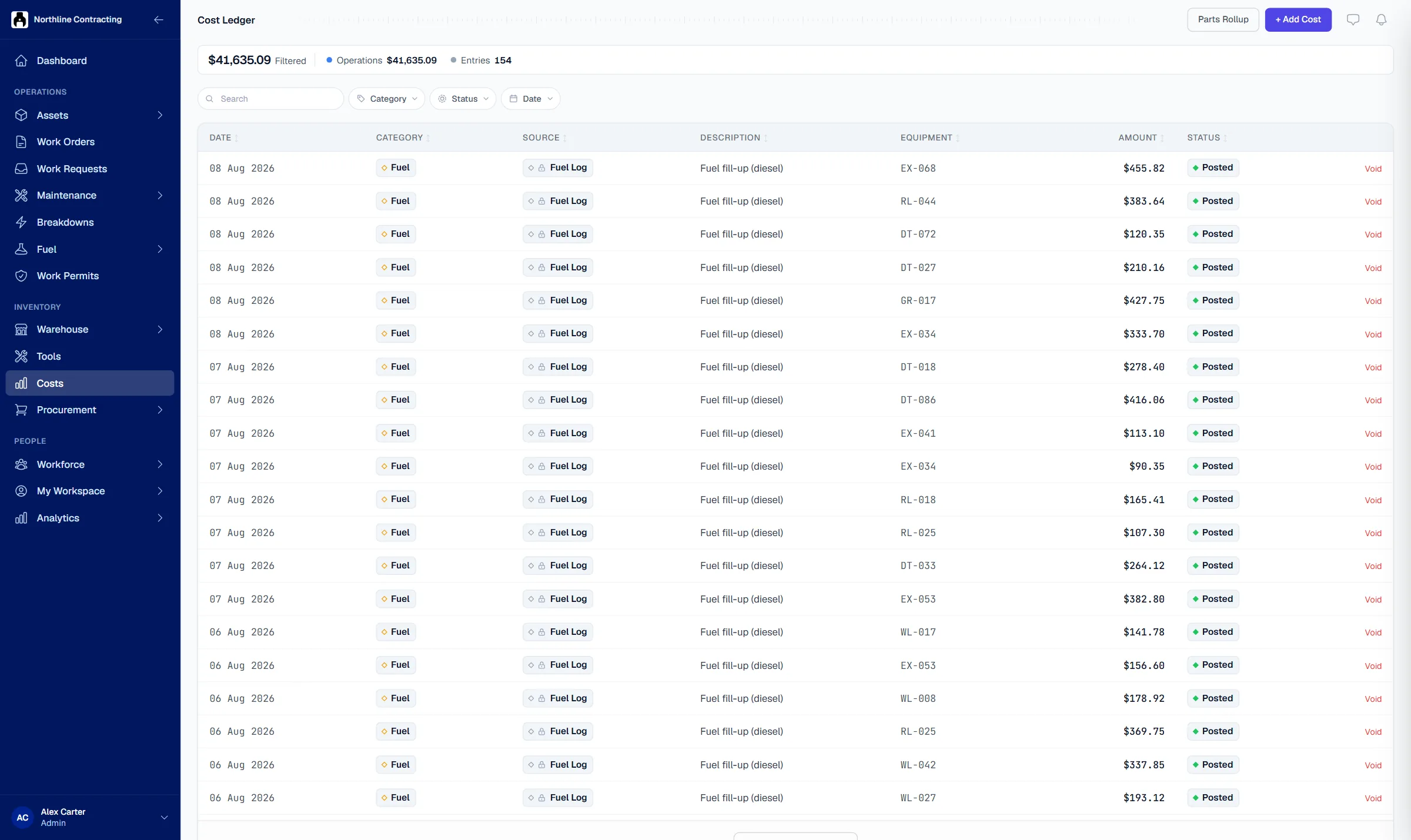
Fuel fills and part issues post themselves into one cost ledger the moment they happen. Manual entries cover the rest. The result: a machine's true cost of ownership, defensible line by line.
Costs & fuel
Log a fuel fill, issue a part — the ledger row writes itself, tied to the machine and the work order. Re-post the same transaction and it updates in place instead of duplicating. Accountants call that idempotent; we call it correct.
Every fill-up is logged per machine — litres, station, meter reading — and lands in the cost ledger the same second. Burn rates per machine come free.
Open any machine and read its money: lifetime, this year, this month, last 30 days, by category. The keep-or-replace argument finally has numbers behind it.
Wrong entry? It's voided with a reason and kept — the financial record never loses a row. Every change sits on an activity timeline an auditor can walk.
From the operational records themselves. A fuel entry and a warehouse issue each post their own line to a single cost ledger as they happen, so cost per machine is a consequence of the work being recorded rather than a separate exercise somebody does at month end.
Yes, for any machine that has meter readings, because operating hours come from meter history rather than from the fuel rows. A machine with fewer than two readings in the period is reported as unmeasured rather than being given a figure, since a machine that burned fuel with no recorded hours is exactly the one a manager should see.
It compares each fill against that machine's own median consumption rather than against a fleet or manufacturer figure, because a water truck and an excavator share no vocabulary on litres per hour. A fill well above or well below the machine's own baseline is held for confirmation with the deviation stated, and a fill larger than the machine's stated tank is impossible by arithmetic rather than by threshold.
Yes, a typeset A3 fuel management report: consumption and spend, efficiency against the fleet's own group medians, a ranked equipment table, a station summary, an exception register and a projection. Where a figure would need evidence Solmex does not record, such as a receipt image or a GPS trace, the report names the absence instead of manufacturing the number.
Log a fuel fill, watch the ledger row appear, and pull one machine's lifetime cost — in a 30-minute walkthrough.
NO COMMITMENT · YOUR DATA STAYS YOURS