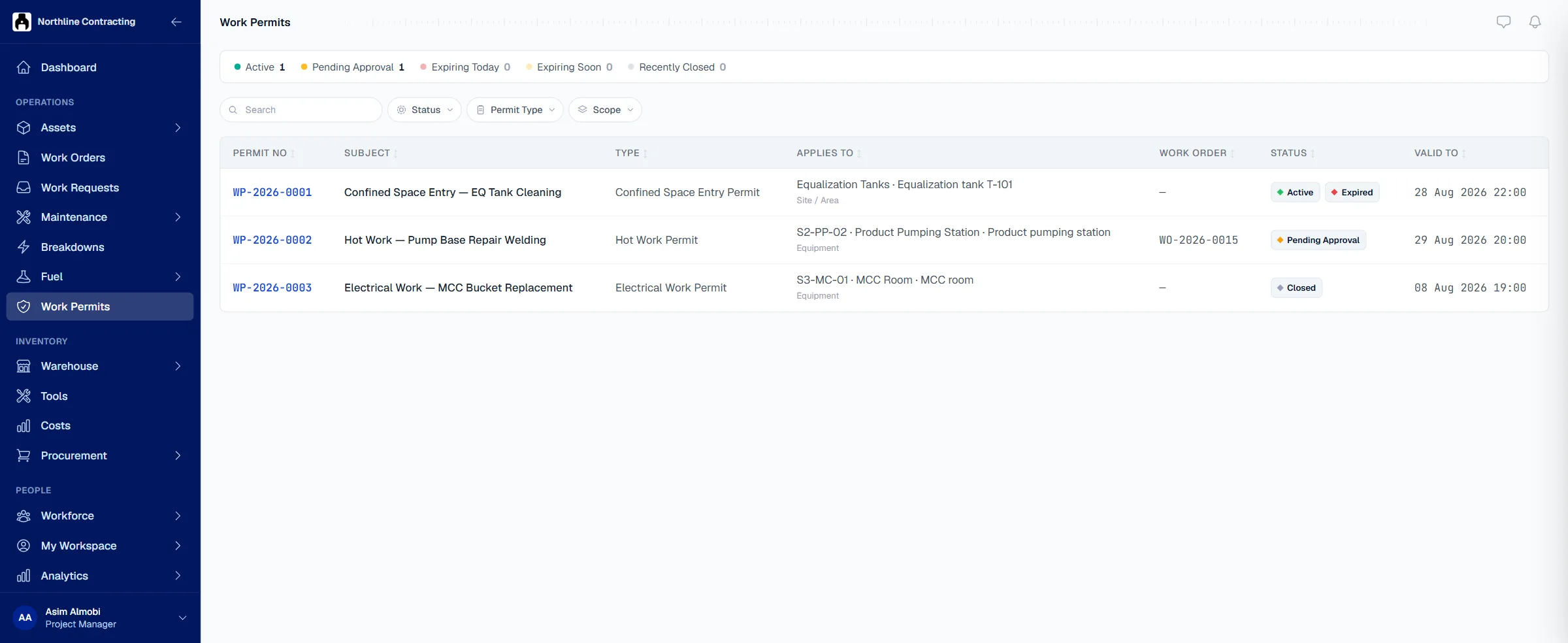
Hot work, confined space, electrical isolation, working at height — every hazardous job runs on a permit with a real lifecycle: drafted, approved, signed, activated, closed. Enforced by the system, not by habit.
Work permits · HSE
Every transition is validated server-side — a permit can't skip approval, can't be edited after closing, can't quietly expire unseen. The work order shows its permits in a safety banner, right where the wrench turns.
Named, reusable templates per permit type pre-fill hazards, PPE, isolations, checklists, fire watch and rescue plans — your HSE standard, applied the same way every time.
A closed or cancelled permit is frozen forever — the signed PDF snapshot is filed automatically. Continuing the job means duplicating into a new permit, preserving the audit trail.
Every printed permit carries a QR code. Anyone at the job front scans it and sees the live permit — valid, expiring, or dead — instead of trusting a sheet that might be stale.
Fourteen, including hot work, confined space, electrical isolation, work at height, excavation and lifting. Each type ships with default hazards, PPE, isolations, checklist, fire watch, gas test and rescue plan content that you then edit, and you can keep several named templates per type.
Yes. A permit can be issued for a site, for one machine, for a work order, or for a group of machines. Welding ten excavators in one bay is one hot work permit covering ten machines, not ten permits, and the covered set is what every filter, report and rule reads.
No, and that is the point. Closed and cancelled are terminal: edits, signatures and uploads are all refused once a permit reaches them. Continued work duplicates the permit into a new one, which keeps the record of what was authorised on the day it was authorised.
Yes. Every permit produces a branded PDF with a QR code that opens a field-optimised page for that permit, and printing or downloading it is itself recorded on the permit's timeline alongside every approval, signature and status change.
Draft a hot-work permit from a template, route it through approval, and scan the printed QR — in a 30-minute walkthrough.
NO COMMITMENT · YOUR DATA STAYS YOURS