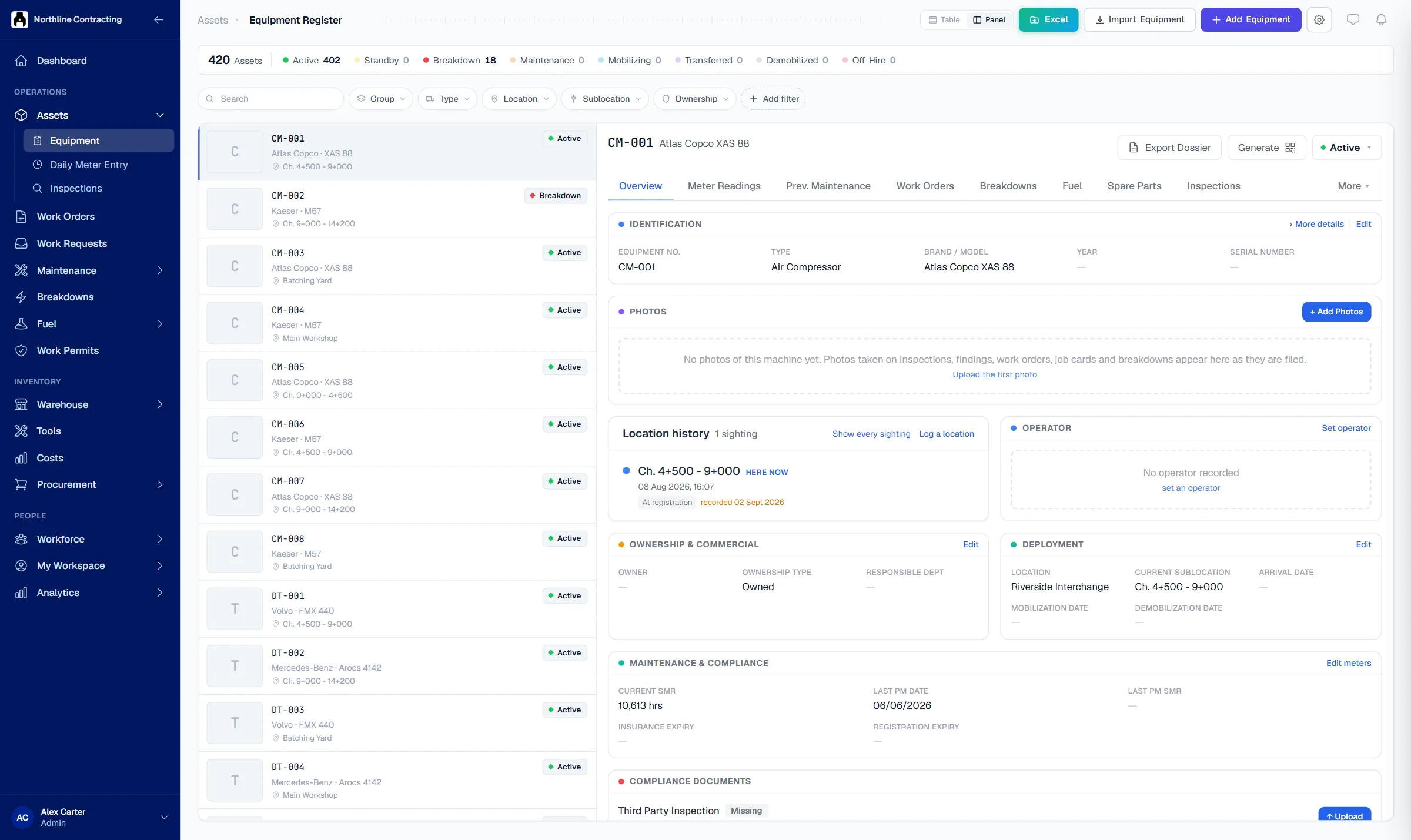
Every excavator, grader, and roller gets a single master record the day it lands on site. Hours, services, breakdowns, parts, costs — everything that ever happens to the machine attaches to it. Nothing is ever deleted.
The equipment backbone
Work orders, fuel fills, part issues, inspections, permits, costs — every module in Solmex points back to the same equipment record. No duplicate registers, no reconciling spreadsheets, no “which list is right?”
Every hour reading is validated against the last — the meter can never run backwards. The master record syncs automatically, so due calculations always run on live hours.
From mobilizing to demobilized, a machine moves through eight statuses. Sold it? Off-hired it? The record stays — with its full history — because someone will ask about it in three years.
Buckets, breakers, and augers are first-class equipment mounted on a host — with their own records. Registration, insurance, and manuals live on the machine, printable as QR labels.
It is one permanent record per machine, and everything else in the system points at it: services, work orders, faults, inspections, parts issued, meter readings, documents and cost. In Solmex an asset is never deleted, only status-changed, so a machine that leaves the site still carries its whole history. That is what makes the true cost of ownership answerable years later.
Yes. Solmex generates an Excel template populated with your own project and zone lists, validates the file before anything is written, and reports every error by row, column and the fix in plain language. The import is all or nothing: one bad row imports nothing, so you never end up with half a register.
No. A machine can carry an hour meter, an odometer, both, or none at all. A breaker, a trailer or a static tank is recorded as having no meter, which is a stated fact rather than a meter reading zero, and Solmex then schedules it on the calendar instead. Up to eight further tracking meters per machine can record process values such as pressure, pH or energy.
Every asset gets a QR label that resolves to that machine's own public card: what it is, its current meter, its last service, when the next one falls due, and a button to report a problem. It works with no login, so an operator or a visiting inspector can scan it and report a fault without an account. The code carries an opaque token, never the internal database id.
See the register running against a real fleet — filters, statuses, meter history and all — in a 30-minute walkthrough.
NO COMMITMENT · YOUR DATA STAYS YOURS