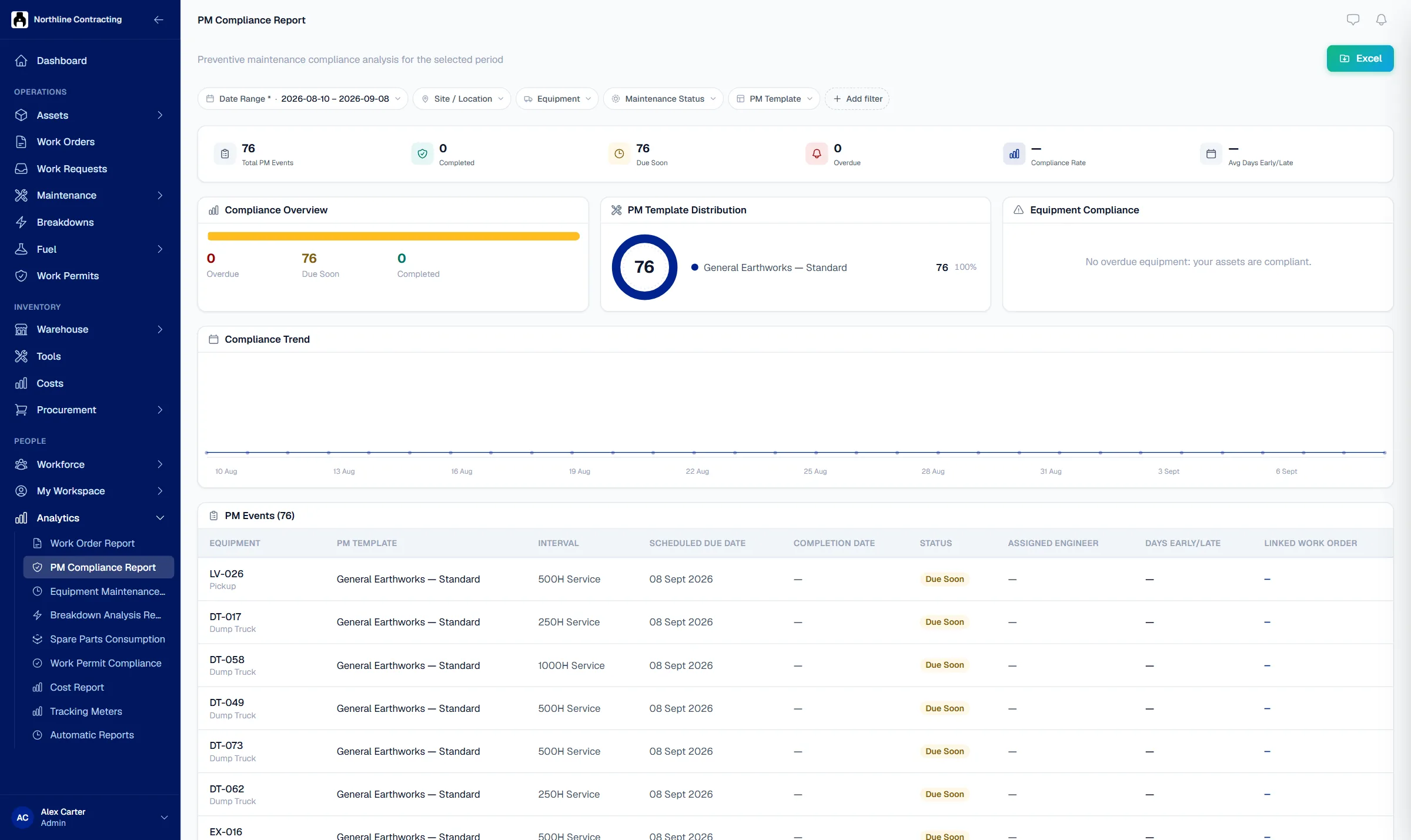
Build a service plan once — 250H, 500H, 1000H, 2000H, 4000H — assign it to a whole machine class, and let live meter readings decide what's due. No calendar guesswork, no wall chart.
Preventive maintenance
Each reading from the field re-runs the due math for every interval on every machine. When a 250H window opens, the queue says so — in hours remaining, not vague dates.
A template holds intervals and their tasks — oil, filters, grease points, torque checks — with part numbers and quantities. Assign it to every grader you own in one move.
On track, due soon, overdue — computed from live hours, never a guess. The due-soon window gives planners time to stage parts and a bay before the machine rolls in.
Every completed service records technicians, supervisor, task checklist, parts and fluids used — then generates a signed-off PDF report and files it on the machine automatically.
Against the manufacturer's fixed milestone grid, not a countdown restarted by the last service. A 250 hour service done late at 285 hours still leaves the next one due at 500, not at 535. Under a subtraction formula one late service would re-phase the machine's whole programme permanently, which is exactly what a manufacturer's schedule is not.
Yes, and on more than one at once. Hour meter and odometer are judged independently, so a truck can be on schedule on hours and overdue on kilometres, with one verdict each. Calendar intervals work the same way for equipment that is serviced by time rather than by use.
You state the last service date and the meter it was done at, and Solmex writes that into the machine's history as a starting point, so the schedule continues from where you actually are instead of reading every machine as never serviced. If you know the date but not the meter, no starting point is invented: a guessed reading would hide a service that is genuinely due, so the machine is flagged for a human instead.
Yes. Logging a service records the technicians, the supervisor, the checklist item by item, the parts and the fluids used, and generates a signed PDF completion report that is filed against the machine and stays in its history. Parts consumed are issued from the spare parts warehouse and priced into the cost ledger in the same action.
Watch a meter reading land and the due queue re-sort itself — then see the six-section service log and the PDF it produces.
NO COMMITMENT · YOUR DATA STAYS YOURS